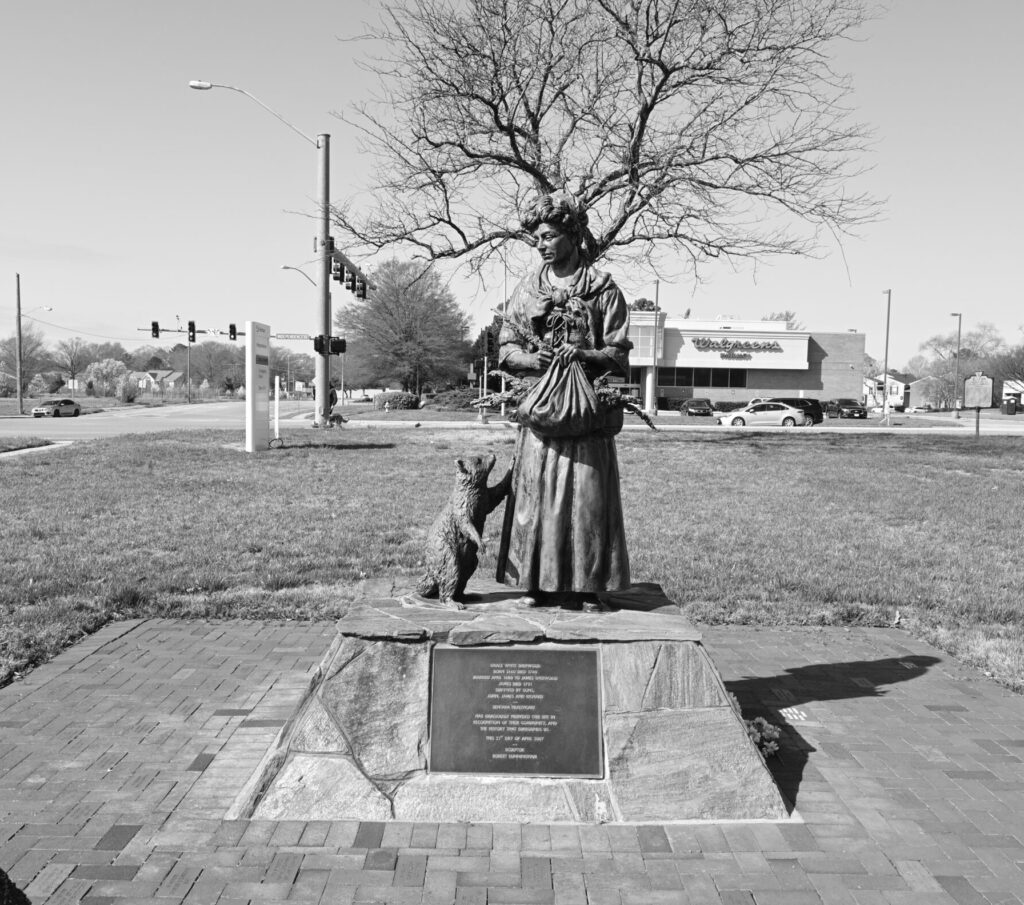
In Virginia Beach, Virginia, there is a road called North Witchduck Road. The name stirs the imagination—some strange bird, perhaps, with a plumage so wild it earned such a title. But that isn’t the case at all. It isn’t a type of duck. It comes instead from the practice of ducking—and not the kind Jeep owners know, where a small plastic duck is left behind as a quiet gesture of recognition.
This is where the story turns, pulling us back into the shadows of pre-revolutionary America and the echoes of witch trials.
Near the intersection of Independence Boulevard and North Witchduck Road stands a statue of Grace White Sherwood. She was tried as a witch and survived the ordeal—but not without suffering. The statue sits not far from where the old courthouse once stood, and the road itself traces what would have been the path from judgment to water—from accusation to trial.
That water is now known as Witchduck Bay.
Grace Sherwood’s story is both fascinating and unsettling. She was accused of witchcraft three times, the final accusation leading to a trial by ducking. Her fate was to be decided by water: if she floated, she was guilty; if she sank, she was innocent—though innocence came at the cost of her life.
At the time, water was believed to be pure, something that would reject evil. And so, the test was carried out with quiet certainty.
On the day of her trial, Grace was stripped and examined for anything that might aid her escape and a sack was placed around her. She was then bound crosswise—right thumb to left toe, left thumb to right—her body forced into a shape that left little room to struggle. and she was rowed out into the water.
Then she was released.
She floated.
Not sinking. Not disappearing. Just… there.
There was no outcome that would have set her free.
To confirm the verdict, the sheriff tied a 13-pound Bible around her neck and forced her under again. This time, she sank—but she did not die. She escaped and was pulled from the water, declared guilty, and imprisoned for several years before eventually being released.
There is a quiet persistence to history in places like this. It lingers in road names, in waterways, in statues that stand watch over the present. Grace Sherwood’s story is not confined to books—it is embedded in the landscape itself.
When I look upon her statue, I don’t see a witch. I see a solemn person, someone trying to make her way through life, caught in something far larger than herself.
Not a symbol. Not a legend. Just a woman who found herself on the wrong side of fear.
Her story lingers here—in the road name, in the water, in the quiet presence of her likeness.
It makes me wonder how often fear has shaped the stories we tell… and the judgments we pass.
We like to believe we’ve moved beyond such things.
But standing there, at the edge of North Witchduck Road, I’m not entirely sure.